
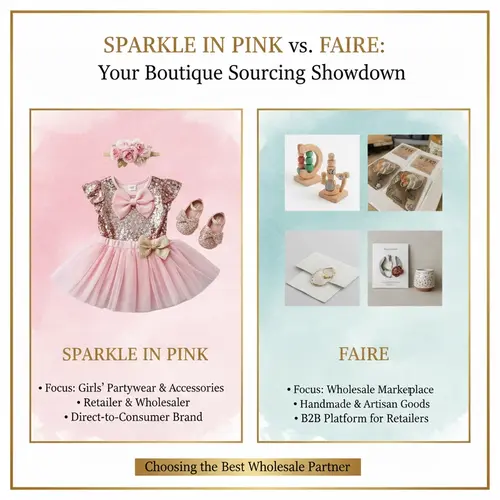

When you’re standing at the crossroads of a new season, the Sparkle In Pink vs Faire debate is likely at the top of your mind. Sourcing is the heartbeat of your business.
Choosing where to spend your inventory budget is the single most important decision you will make this year. The right sourcing partner can mean the difference between shelves of stagnant stock and a thriving business with repeat customers. If you choose the wrong partner, you’re stuck with “dead stock” (inventory that doesn’t sell) and drained margins, putting your entrepreneurial dream at risk. If you choose right, your brand becomes the go-to destination for parents seeking unique, quality, and on-trend items for their little ones.
In the red corner, we have Sparkle In Pink (SIP), the undeniable darling of the affordable, high-trend children’s boutique world, known for its vibrant designs and accessible price points. In the blue corner, we have Faire, the massive, tech-driven marketplace that has revolutionized how independent brands connect with retailers, offering unparalleled variety and innovative payment terms.
But which one is actually better for your specific business model, your budget, and your target audience in 2026? Let’s break it down, examining every facet from their fundamental structure to the nitty-gritty of shipping, customer service, and the ever-important profit margins. By the end of this guide, you’ll have a clear roadmap to make an informed decision for your boutique’s success.
What Is Sparkle In Pink?
Sparkle In Pink is a U.S.-based boutique clothing brand and supplier specializing primarily in children’s clothing, especially girls’ outfits, matching family sets, accessories, and seasonal apparel.
Unlike large wholesale marketplaces, Sparkle In Pink operates as a direct brand supplier, offering retailers access to its own curated collections.
Who Sparkle In Pink Is Best For
Children’s boutique owners
Girls’ clothing stores
Niche boutiques focused on trendy, seasonal styles
Dropshippers testing kidswear without inventory
What Is Faire?
Faire is a global wholesale marketplace connecting independent retailers with thousands of brands across multiple categories — apparel, kids, home, beauty, food, stationery, and more.
Faire is not a supplier itself. Instead, it acts as a B2B platform where brands sell wholesale directly to retailers.
Who Faire Is Best For
Multi-category boutiques
Brick-and-mortar stores
Retailers buying inventory in bulk
Stores wanting brand variety under one account
1. The Fundamental Difference: Brand vs. Marketplace – Understanding Their Core Identity
Before we talk about prices, product lines, or shipping timelines, it is absolutely crucial to grasp the foundational identity of these two entities. This understanding will frame every subsequent comparison.
Sparkle In Pink (SIP): A Vertically Integrated Brand and Direct Supplier
At its heart, Sparkle In Pink is a single, vertically integrated brand. What does this mean for you, the boutique owner?
In-House Design & Manufacturing: The vast majority of items you see on Sparkle In Pink are designed, sourced, and often manufactured specifically for their brand. They have a distinct aesthetic—think vibrant colors, playful patterns, an abundance of ruffles, sequins, bows, and often matching “Mommy & Me” sets.
Direct-to-Consumer & Wholesale: While they operate a thriving direct-to-consumer retail website, they also offer a dedicated wholesale program. This means you are buying directly from the brand that creates the products.
Consistent Aesthetic: Because it’s one brand, you can expect a very cohesive look and feel across all their product categories. If you love their style, you can stock your entire store from SIP and have a perfectly harmonized collection.
Quality Control (Single Point): While quality can always vary with any manufacturer, with SIP, there’s a single point of responsibility. If you experience consistent quality issues, you know exactly who to address.
Faire: The Expansive B2B Wholesale Marketplace
In stark contrast, Faire is not a brand; it’s a sophisticated B2B (Business-to-Business) marketplace. Faire acts as a digital intermediary, connecting hundreds of thousands of independent brands and makers with millions of retailers worldwide.
Curated Selection of Independent Brands: Faire’s value lies in its immense diversity. It hosts everything from artisanal candle makers and handcrafted jewelry designers to boutique clothing lines, organic baby wear, and unique home goods. You’re not buying from Faire; you’re buying through Faire, from individual brands that use Faire as their sales platform.
Technological Infrastructure: Faire provides the robust technological backbone—order processing, payment systems (including their famous Net 60 terms), shipping integration, and dispute resolution—that makes wholesale buying seamless for retailers and selling accessible for small brands.
Diverse Aesthetics & Product Categories: The variety on Faire is virtually endless. You can find high-end organic cotton sleepers from one vendor, minimalistic wooden toys from another, whimsical stationery, and unique home decor, all within the same platform. This allows for incredible curation and differentiation for your boutique.
Decentralized Sourcing: When you place an order on Faire, you’re often placing multiple individual orders with different brands. Each brand then fulfills its portion of your order independently.
The Winner in This Category:
Faire unequivocally wins for variety and breadth of selection. If your goal is to curate a unique, multi-brand collection with diverse aesthetics and product categories, Faire is the clear choice.
Sparkle In Pink wins for brand cohesion and simplicity. If you’re building a boutique with a very specific, consistent aesthetic that aligns with SIP’s style, sourcing entirely from them can streamline your inventory management and branding efforts.
2. Pricing and Profit Margins: Where the Money Is Made (or Lost)
Understanding the cost structure and potential for profit is paramount for any retail business. Both Sparkle In Pink and Faire offer different advantages and disadvantages in this critical area. In the boutique world, aiming for a “Keystone Markup” (doubling your cost to set your retail price) is often considered the bare minimum to cover overheads and make a sustainable profit.
Sparkle In Pink Pricing Strategy: High Volume, High Margins
Sparkle In Pink has built its empire on the “Affordable Boutique” model. Their wholesale prices are designed to allow retailers to offer competitive pricing while still achieving robust profit margins.
Wholesale Price Point: SIP is known for its incredibly low wholesale unit costs. You can frequently find full children’s outfits (top + bottom or a dress) for anywhere between $5 and $12. Individual items like leggings, tops, or accessories might be even lower.
High Retail Profit Potential: Given these low wholesale costs, you can comfortably retail these items for $20–$35, sometimes even higher for elaborate pieces or seasonal collections. This allows for profit margins often exceeding 60%, making SIP an attractive option for maximizing per-item profitability.
Bulk Discounts & Rewards: While not always explicit “bulk discounts” in the traditional sense, Sparkle In Pink operates a “Sparkle Bucks” rewards program. This loyalty program effectively acts as a cashback or store credit system for frequent or high-volume buyers. The more you spend, the more Sparkle Bucks you accrue, which can then be applied to future wholesale orders, further reducing your effective cost of goods.
Minimum Order Value (MOV): SIP typically has very reasonable MOVs, often around $50 to $100. This makes it highly accessible for new boutiques or those with limited initial capital, allowing them to test the waters with smaller, more frequent orders.
Faire Pricing Strategy: Diverse Costs, Value-Added Terms
Faire, as a marketplace, presents a more varied pricing landscape. The wholesale price of an item is set by each individual brand.
Variability of Pricing: You will find an enormous range of prices on Faire, from budget-friendly items similar to SIP to high-end artisanal goods costing significantly more. A single organic cotton baby romper might wholesale for $18-$25, while a hand-knitted beanie could be $10-$15.
The “Marketplace Tax” (Commissions): This is a critical factor. Brands selling on Faire pay a commission to Faire for facilitating the sale (typically 15% on reorders and 25% on a new retailer’s first order). To offset these costs, many brands price their wholesale items slightly higher on Faire than if you were to purchase directly from their own wholesale website. This means your cost of goods might be marginally higher on Faire for the same product from the same brand, compared to buying directly.
Net 60 Payment Terms: Faire’s Game Changer: This is arguably Faire’s biggest financial advantage for retailers. Eligible retailers (after a quick credit check) can place orders and defer payment for 60 days. This is a massive boon for cash flow management. You can receive your inventory, start selling it, and potentially even make sales before you have to pay for the stock. This significantly reduces the upfront capital needed and minimizes risk, especially when stocking up for peak seasons like holidays.
Faire Insider Program (Shipping Savings): While not a direct pricing factor, Faire offers a “Faire Insider” subscription for $19.99/month. This program provides free shipping on most orders (from participating brands) and exclusive daily deals. For any boutique regularly ordering from Faire, this subscription is almost a mandatory investment to keep shipping costs from eating into your margins. Without it, individual shipping charges from multiple vendors can quickly accumulate.
The Winner in This Category:
Sparkle In Pink wins for absolute lowest unit cost and highest per-item profit margin potential, making it ideal for high-volume, affordable boutique models.
Faire wins for financial flexibility and risk mitigation due to its revolutionary Net 60 payment terms and the comprehensive “Faire Insider” program that, when utilized, can significantly reduce overall landed costs.
3. Shipping, Speed, and Logistical Simplicity
Once you’ve decided on your products, the next major hurdle is getting them into your hands (and then to your customers) efficiently. The logistics of shipping can make or break your inventory planning and customer satisfaction.
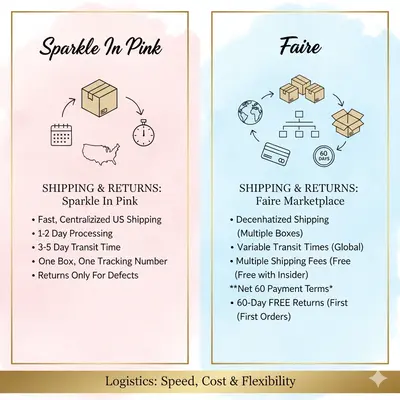
Sparkle In Pink: Predictable, Fast, and Centralized
SIP operates a streamlined, centralized shipping model.
Shipping Origin: All Sparkle In Pink wholesale orders ship directly from their main warehouse in Utah, USA.
Speed: This is one of SIP’s strongest points. Most wholesale orders are processed and shipped within 24–48 hours (often even faster during non-peak times). You can generally expect to receive your order within 3-7 business days, depending on your location within the US. This rapid turnaround is crucial for boutique owners needing to restock quickly or capitalize on sudden trends.
Reliability: Because all products come from a single warehouse, the shipping process is highly predictable. You receive one tracking number and one package (or a few packages if your order is very large). This simplicity minimizes errors and makes inventory receiving much more manageable.
Shipping Costs: Standard shipping rates apply based on weight and destination. While not free, they are generally competitive and predictable, as you’re receiving a single shipment from a single location.
Faire: Diverse, Decentralized, and Potentially Complex
Shipping on Faire is inherently more complex due to its marketplace nature.
Decentralized Shipping: If you place an order with five different brands on Faire, you will receive five separate shipments, each originating from the individual brand’s location (which could be anywhere in the world). This means five different tracking numbers, five different estimated delivery dates, and potentially five different shipping carriers.
Variability in Speed: The shipping speed will vary wildly depending on the individual brand’s operational efficiency. Some brands on Faire are large, highly organized operations that ship within a day; others are small, artisanal makers who might take a week or more to process and ship an order. This variability requires careful planning and communication with each vendor.
Accumulated Shipping Costs (Without Faire Insider): If you don’t subscribe to Faire Insider, you will pay individual shipping charges for each order placed with a different brand. These costs can quickly accumulate and significantly eat into your profit margins, especially if you’re placing smaller orders from many different vendors.
Faire Insider Benefits: As mentioned, the Faire Insider subscription is almost essential for active users. It provides free shipping from many participating brands, turning a potential logistical and financial headache into a more manageable situation.
International Shipping: Faire also facilitates international wholesale. While this opens up a world of unique products, international shipping comes with its own set of complexities, including longer transit times, potential customs delays, and import duties/taxes, all of which need to be factored into your pricing and delivery estimates.
The Winner in This Category:
Sparkle In Pink wins for logistical simplicity, speed, and predictable shipping costs. If you value a straightforward, fast, and centralized receiving process, SIP is superior.
Faire offers immense variety but demands more attention to detail and strategic use of the Faire Insider program to manage the complexities and costs of decentralized shipping. For sheer global reach and unique product acquisition, Faire is unmatched, but requires more active management.
4. Pros and Cons: A Quick Comparison at a Glance
To help crystallize the differences, here’s a direct comparison of the key features that matter to boutique owners:
| Feature | Sparkle In Pink | Faire Marketplace |
| Product Variety | Limited to their specific, cohesive style. | Unlimited, with 100,000+ independent brands globally. |
| Price Point | Budget-friendly wholesale, allowing for high retail margins. | Varies by brand, from budget to luxury; potential for slightly higher COGS due to commissions. |
| Minimum Order | Very low (often $50-$100), highly accessible. | Varies by brand (some as low as $50), but often higher for unique goods. |
| Payment Terms | Standard credit card/PayPal upfront payment. | Net 60 terms (pay 60 days later) for eligible retailers, a major cash flow advantage. |
| Returns Policy | Limited to defects or incorrect orders. Standard wholesale terms. | 60-day free returns on first orders from a new brand – huge risk reduction. |
| Shipping Speed | Consistently fast (1-2 day processing) from a single US warehouse. | Varies by brand; can be slow if dealing with small makers or international brands; multiple shipments. |
| Shipping Costs | Predictable, standard carrier rates from one location. | Can be costly without Faire Insider; multiple shipments; free shipping with Insider. |
| Product Exclusivity | Anyone can buy it (high market saturation, competition). | Can filter for unique, handmade, or “not on Amazon” products for differentiation. |
| Customer Service | Direct with Sparkle In Pink; generally responsive. | Through Faire’s platform for disputes, but often involves direct communication with individual brands. |
| Finding New Products | Limited to their new collections. | Constant stream of new brands, trends, and product categories. |
| Brand Identity | Best for boutiques aiming for the “SIP aesthetic.” | Ideal for curating a unique, multi-brand identity. |
5. The "Vibe" Check: Aligning with Your Boutique's Brand and Customer
The products you source must resonate deeply with your boutique’s brand identity and, more importantly, with your target customer. This isn’t just about price; it’s about the emotional connection and lifestyle your products represent.
Scenario A: The "Instagram Mom" & Trendy Boutique
If your boutique caters to the modern “Instagram mom” who loves to dress her child in eye-catching, festive, and affordable outfits for social media, parties, or everyday cuteness, then Sparkle In Pink is your undisputed goldmine.
Aesthetic: Think vibrant colors, adorable ruffles, playful prints, holiday-themed “punny” shirts, glitter, sequins, and all things charmingly whimsical. Their “Mommy & Me” collection is arguably the best in the industry for its price point, tapping directly into a highly sought-after trend.
Customer Expectation: These customers are often looking for high-value items that look great in photos, are perfect for themed events (birthdays, holidays, photo shoots), and are budget-friendly enough for frequent purchases or rapid wardrobe updates. They might prioritize “cute factor” and affordability over organic certifications or artisanal craftsmanship.
Marketing Fit: SIP products practically market themselves on platforms like Instagram and TikTok, fitting perfectly into short-form video content and engaging photo carousels.
Scenario B: The "High-End, Eco-Conscious, or Curated" Boutique
If your customers are more discerning, prioritizing sustainability, organic materials, minimalist design, or unique artisanal craftsmanship, then you will find very little that aligns with your brand at SIP. This is where Faire becomes indispensable.
Aesthetic: Your customers might seek GOTS-certified organic cotton sleepers, neutral “sad beige aesthetic” baby wear, hand-carved wooden toys, ethically sourced accessories, or unique, small-batch clothing from independent designers. They value quality, origin story, and often a more subdued, natural palette.
Customer Expectation: These customers are willing to pay a premium for products that align with their values (sustainability, fair trade, non-toxic materials), durability, and timeless design. They are less about fleeting trends and more about investing in quality pieces.
Brand Examples on Faire: On Faire, you can source renowned brands like Mushie (silicone feeding products, minimalist toys), Copper Pearl (trendy baby blankets, bibs), Quincy Mae (organic baby clothing with muted tones), and thousands of other unique brands that offer distinct value propositions.
Marketing Fit: Products sourced from Faire often lend themselves to storytelling about the maker, the materials, and the unique design, appealing to a customer who values substance and exclusivity.
The Winner in This Category:
This is a tie, as the “winner” is entirely dependent on your specific boutique’s brand identity and the demographics of your ideal customer. Neither is inherently better; they simply serve different market segments. Understanding your niche is the key here.
6. Why a Hybrid Sourcing Model is Your 2026 Competitive Advantage
The most successful boutique owners in 2026 understand that loyalty to a single supplier can limit growth and stifle creativity. Instead, they embrace a Hybrid Sourcing Model, leveraging the distinct strengths of both Sparkle In Pink and Faire to build a robust, diverse, and profitable inventory.
Strategically Using Sparkle In Pink:
“Bread and Butter” Best-Sellers: Use SIP for your core, high-volume items that move quickly. These are your reliable sellers that generate consistent revenue. Think everyday dresses, themed outfits for holidays (e.g., Christmas, Halloween), or popular character-inspired pieces.
Loss Leaders & Traffic Drivers: Given their incredibly low wholesale prices, SIP items can serve as excellent “loss leaders.” You might price a popular item very competitively (even at a slightly lower margin) to attract new customers to your shop. Once they’re there, they’ll discover your other, higher-margin items.
Seasonal & Trend-Driven Inventory: Sparkle In Pink excels at quickly producing on-trend items. Use them to capitalize on seasonal demands or fleeting fashion trends in children’s wear without making a huge upfront investment. Their fast shipping allows you to react quickly to market shifts.
Promotional Items & Free Gifts: The low cost of SIP items makes them perfect for bundling with other products, offering as incentives for higher-value purchases, or giving away as promotional gifts to loyal customers.
Strategically Using Faire:
Anchor Brands & Signature Pieces: Utilize Faire to discover unique, “anchor brands” that define your boutique’s identity and give it a premium feel. These might be your higher-priced, ethically made organic cotton sets, exclusive wooden toys, or artisanal accessories that set your shop apart from competitors. These items often tell a compelling story, which resonates with discerning customers.
Unique Product Differentiation: With Faire’s vast selection, you can find products that truly differentiate your boutique. Look for brands that are “not on Amazon,” that offer handmade quality, or that align with niche trends your target audience craves but can’t easily find elsewhere.
Capitalizing on Net 60 Terms for Growth: This is where Faire’s financial power shines. Use the Net 60 payment terms to stock up for major selling seasons (e.g., spring, back-to-school, holidays) without tying up all your working capital. This allows you to invest in a larger, more diverse inventory than your immediate cash flow might otherwise permit, giving you a significant competitive edge. Imagine filling your shelves for Christmas in October, knowing you don’t have to pay until January!
Testing New Categories with Reduced Risk: Faire’s 60-day free returns on first orders from any new brand is a game-changer. This policy allows you to confidently experiment with new product categories or brands without the fear of being stuck with unsold inventory. Want to see if your customers like organic baby skincare? Try a small order from a new Faire brand, and if it doesn’t sell, you can return it. This significantly lowers the barrier to diversification.
Example of a Hybrid Strategy:
A boutique might source colorful, affordable princess dresses and themed t-shirts from Sparkle In Pink for their “Everyday Play” collection and holiday sales. Simultaneously, they might use Faire to source premium organic cotton layette sets, unique wooden teethers, and handcrafted baby shoes from independent makers for their “Elevated Essentials” and “Gift Registry” sections. This combination appeals to a broader customer base and allows for flexible pricing tiers.
7. Conclusion: The Final Verdict for Your Boutique's Future
In the dynamic world of online retail, making informed sourcing decisions is paramount. Both Sparkle In Pink and Faire offer compelling advantages, but they cater to fundamentally different needs and business models. There isn’t a single “better” option; there’s only the option that is better for you, right now.
If you are a brand new boutique owner with less than $1,000 in initial inventory capital, prioritizing high-volume, low-cost inventory, and a fast turnaround, then Sparkle In Pink is your ideal starting point. You can acquire more saleable items for your money, and their rapid domestic shipping means you can launch and start generating revenue almost immediately. The consistent aesthetic also simplifies initial branding efforts.
If you are an established boutique looking to scale, diversify your product offerings, cultivate a unique brand identity, or manage cash flow strategically, then Faire is an indispensable tool. The immense variety, the ability to find exclusive brands, the Net 60 payment terms, and the generous return policy for first orders provide a level of flexibility and risk mitigation that SIP cannot match. Faire empowers you to build a curated, multi-brand experience that truly stands out.
Crucial Final Advice:
No matter which platform you lean towards (or if you choose both), always pay meticulous attention to the details.
On Faire: Always check the “Ship from” location for each brand. While Faire is global, overseas shipping can significantly extend delivery times and introduce unexpected import duties or taxes, which can quickly erode your profit margins if not accounted for in your pricing. Also, ensure you leverage the Faire Insider program if you plan to be an active buyer.
On Sparkle In Pink: Keep an eye on their new arrivals and sales sections. They frequently update their inventory, and catching a popular item on sale can boost your margins even further. Understand their sizing charts, as children’s clothing sizing can vary between brands.
By strategically integrating both Sparkle In Pink and Faire into your sourcing strategy, you position your boutique for maximum profitability, unique product offerings, and sustainable growth in the competitive 2026 children’s fashion market. The choice isn’t about one over the other, but how you can leverage each to build the most resilient and beloved brand possible.
Frequently Asked Questions: Sparkle In Pink vs Faire
1. Does Sparkle In Pink offer free shipping on wholesale orders?
Yes, but with specific conditions. Sparkle In Pink typically offers free standard shipping on orders over $75 within the United States. For a boutique owner, this low threshold is incredibly helpful for small “restock” orders, as it compares favorably to the high shipping costs often associated with individual Faire brand orders.
2. How do Faire’s Net 60 terms actually work?
Net 60 terms are a “Buy Now, Pay Later” system for retailers. If you are approved, Faire pays the brand upfront for your order, but you don’t pay Faire until 60 days later. This is designed to let you sell the products and generate profit before the bill is due. If you return an item within the 60-day window, you aren’t charged for that item at all.
3. Is Sparkle In Pink clothing high quality?
Sparkle In Pink maintains high quality by owning its own manufacturing and printing facilities. With over 125,000 5-star reviews, the consensus is that the clothing is durable and “true to size.” While the price is low, they use high-quality prints and fabrics that are designed to last through “rowdy” toddler play.
4. Can I return items to Faire if they don’t sell?
Yes, but only on your very first order with a specific brand. This is Faire’s “Risk-Free” trial. You have 60 days to return unsold items from that first order. Any reorders or subsequent orders from that same brand are considered final sale (unless defective).
5. Where does Sparkle In Pink ship from?
All orders ship from their centralized warehouse in Bluffdale, Utah. This makes shipping times much more predictable than Faire, where products might ship from thousands of different locations across the globe.
6. Is there a “minimum order” for Faire and SIP?
Sparkle In Pink: Has a very low barrier to entry, often allowing you to check out with as little as $50-$100.
Faire: Minimums are set by the individual brands. Some brands have a $50 minimum, while others might require $500.
7. Does Faire charge a membership fee?
No, it is free to join Faire as a retailer. However, to get the most value, many boutique owners join Faire Insider for about $19.99/month to get free shipping across most of the platform.
8. How does the Sparkle In Pink “Sparkle Bucks” program work?
It is a rewards program where you earn 1 point (Sparkle Buck) for every cent spent. 100 Sparkle Bucks equal $1 in store credit. This acts as a consistent discount for loyal wholesale buyers that you won’t find on a marketplace like Faire.
9. Can I use Sparkle In Pink photos for my website?
Yes, SIP generally allows wholesale customers to use their professional photography to help sell the items, which saves you hundreds of dollars on photoshoots. Faire also provides high-quality imagery from their brands.
10. Which is better for a “Mommy and Me” niche?
Sparkle In Pink is the clear winner for “Mommy and Me.” They have a dedicated category for matching sets that are designed in-house to coordinate perfectly. While you can find matching sets on Faire, you would likely have to source them from multiple different brands, making it harder to maintain a consistent look.
Read more:
- How to Start a Children’s Boutique Online (2026 Guide)
- Sparkle In Pink Wholesale and Dropshipping- 2026 Review
- Wessi Wholesale, Dropshipping & Business Guide Review 2026
- FootwearUS Wholesale & Dropshipping Shoes for Retailers
- Dracula Clothing Review 2026 – Gothic Fashion & Wholesale
- AI Dropshipping Tools 2026: What You Need Now
- Verpex Hosting – Complete Overview
- AJJ Cornhole: Premium Boards for Smart Resellers
- Phi Villa US Review: Outdoor Furniture & Business Tips 2025
- Dropshipping 2025: Beginner Guide + Top 100 Suppliers
Affiliate Disclaimer:
This post contains affiliate links. If you purchase through these links, we may earn a small commission — at no extra cost to you. This helps support our blog and allows us to keep creating helpful content. Thank you for being so supportive!
